Horizontal County Logo
Cumberland County Logo white - Horizontal

East Central Water and Sewer District

The Public Utilities Department is requesting that the Board of Commissioners establish a Water and Sewer District for the East Central community for the purpose of applying for grants and low-interest rate loans. The East Central community has been impacted with contaminated wells due to PFAS from the Fayetteville Works Site. This contamination poses health and safety concerns for the community.

PROPOSED EAST CENTRAL WATER AND SEWER DISTRICT

The Cumberland County Board of Commissioners held a public hearing at 6:45 p.m., Tuesday, January 20, 2026, in Room 118 in the Cumberland County Courthouse located at 117 Dick Street, Fayetteville, NC, to consider creating a Water and Sewer District for the East Central area pursuant to NCGS 162A-86. The proposed district is generally described as follows:

The proposed East Central Water and Sewer district begins at the intersection of Maxwell Road (NCSR-1006) and the Cumberland and Sampson County boundary line thence proceeds southerly along the Cumberland and Sampson County boundary line to its intersection with Hollow Bridge Road (NCSR-2030); thence westerly along Hollow Bridge Road to its southern-most intersection with Ava Road (NCSR-2028); thence westerly along Ava Road to its intersection with NC Highway 210; thence northwesterly along NC Highway 210 to its intersection with Macedonia Church Road (NCSR-2014); thence northwesterly along Macedonia Church Road to its intersection with John B Carter Road (NCSR-2010); thence northwesterly along John B Carter Road to its intersection with Maxwell Road; thence northeasterly along Maxwell Road to its intersection with the Cumberland and Sampson County boundary line, the point and place of beginning.

The official map and list of all parcels within the proposed East Central Water and Sewer District are available for inspection during normal business hours at the County Public Utilities Department, 698 Ann Street, Fayetteville, NC. This information can also be found on the Public Utilities website at www.cumberlandcountync.gov/utility.
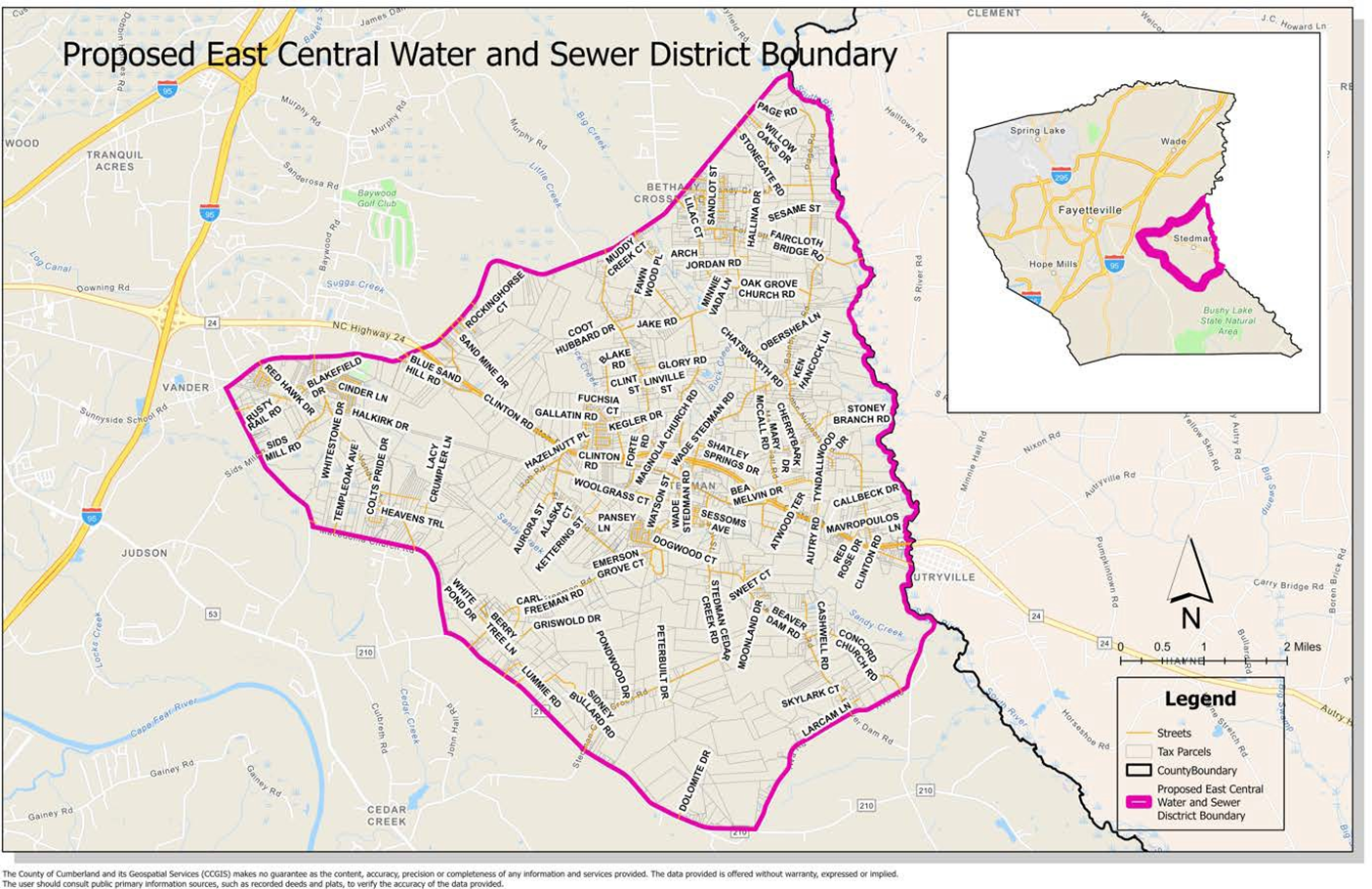
Proposed East Central Water and Sewer District Boundary

Cumberland County is planning for the future of water in this area. Water and sewer systems are often planned together. As water services expand, sewer may become more feasible in the future.

Some private wells have been affected by PFAS contamination.

Creating a district helps the County:

  • Study local water needs
  • Look at possible solutions
  • Apply for state and federal funding

This is a planning step, not a final decision. The Town of Stedman will make decisions about whether or not to join the district.

A water and sewer district is a planning area created under North Carolina law to study, fund, and potentially provide water and sewer services.

The Cumberland County Board of Commissioners serves as the governing board.

The goal is to provide clean, safe, regulated drinking water for our community, now and for future generations.

No. Creating a district does not start construction. Water infrastructure projects take time. First, studies must be done in the water and sewer district to determine the infrastructure needs of the area.

Possibly. As the County plans long-term water solutions, districts may grow or connect with other areas over time.

Costs are not known yet. Before any decisions are made, the County will:

  • Complete engineering studies
  • Identify funding sources
  • Gather community input

Creating a district does not automatically raise property taxes. The governing board of a water and sewer district can choose to levy taxes to fund the district.

No decisions have been made about rates or fees. Those details will come later and will be discussed with the community before any decisions are made.

There is no construction project planned yet. Costs and funding will be evaluated carefully before any project is proposed.

Affordability is a top priority. The County is:

  • Seeking grants and low-interest funding
  • Phasing projects over time
  • Planning carefully before decisions are made

Water infrastructure is very expensive and must be funded over time. Using multiple funding sources helps keep costs more affordable and reduces the burden on taxpayers.

No. Creating a district does not require anyone to connect.

Currently, there is no planned construction project in the proposed East Central Water and Sewer District. First, the County must obtain funding for the engineering reports. Creating a County Water and Sewer District will allow the County access to grant opportunities to pay for these studies to determine needs in the district. 

No decisions have been made about future fees. Once the County has reached that point in the project, any future decisions will include public input.

The County is exploring multiple options, including:

  • Wells
  • Regional partnerships
  • Long-term water supply sources

No final decisions have been made.

Depending on future planning decisions. Options may include:

  • Continuing with PWC
  • Partnering with the County
  • A combination of both

Many residents use private wells. Some wells in the area have been impacted by PFAS.

The Town purchases water from Fayetteville PWC. Information about their water quality can be found on the Fayetteville PWC website.

Learn more about PFAS and water testing.


PFAS are man-made chemicals found in some water sources. They can remain in the environment for a long time. Locally, they have been linked to industrial activity, including the Fayetteville Works (Chemours/Dupont) site.

State and federal agencies set safety guidelines to reduce long-term health risks.

Cumberland County is committed to providing filtered clean, safe, regulated drinking water.

A water system would provide treated, regulated drinking water that meets safety standards and is continuously monitored.

Some residents use filters, but:

  • They require ongoing maintenance
  • They only treat water at one home

A water system provides consistent, regulated treatment at a larger scale with continuous monitoring.

The County is pursuing:

  • State funding (DWI/DEQ)
  • Federal funding (USDA)
  • Grants and low-interest loans

Using multiple funding sources helps reduce costs for residents.

Cumberland County continues to work with state and federal partners and has taken legal action related to PFAS contamination.

At the same time, the County is focused on moving forward with solutions for residents.

Residents will receive updates through:

  • The County website
  • Public meetings
  • Social media
  • Community outreach

There is no set timeline yet. Planning, engineering, and funding must come first. On average, once a district is created and funding is secured, the process can take 5 years or more.

No. This effort is focused on addressing contamination within the district.


  • Contact Information

    Phone: 910-678-7682
    Ann Street Landfill:

    698 Ann Street
    Fayetteville, NC 28301

    Fax: 910-321-6840
    Email:
    email_envelope
    Project Manager: Amy Hall

    Contact Information

    Phone: 910-678-7682
    Fax: 910-321-6840
    Email:
    email_envelope
    Project Manager: Amy Hall
    Ann Street Landfill:

    698 Ann Street
    Fayetteville, NC 28301